A Taiwan Strait wargame built from open sources
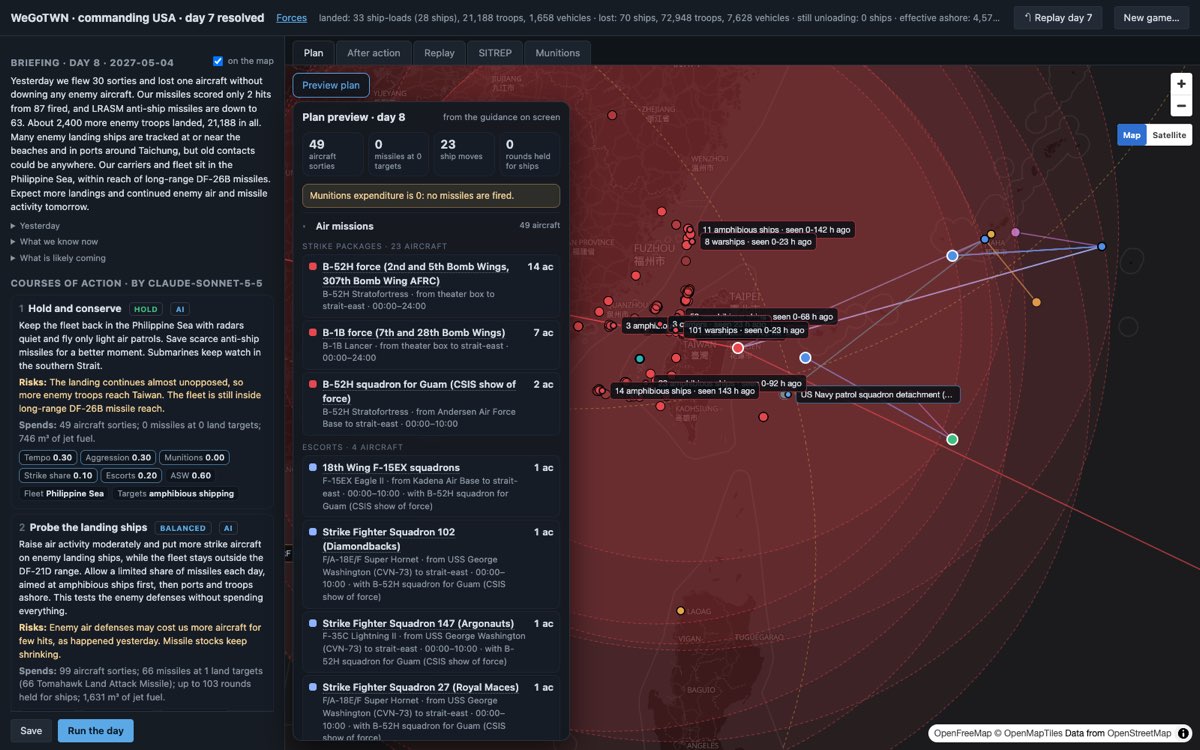
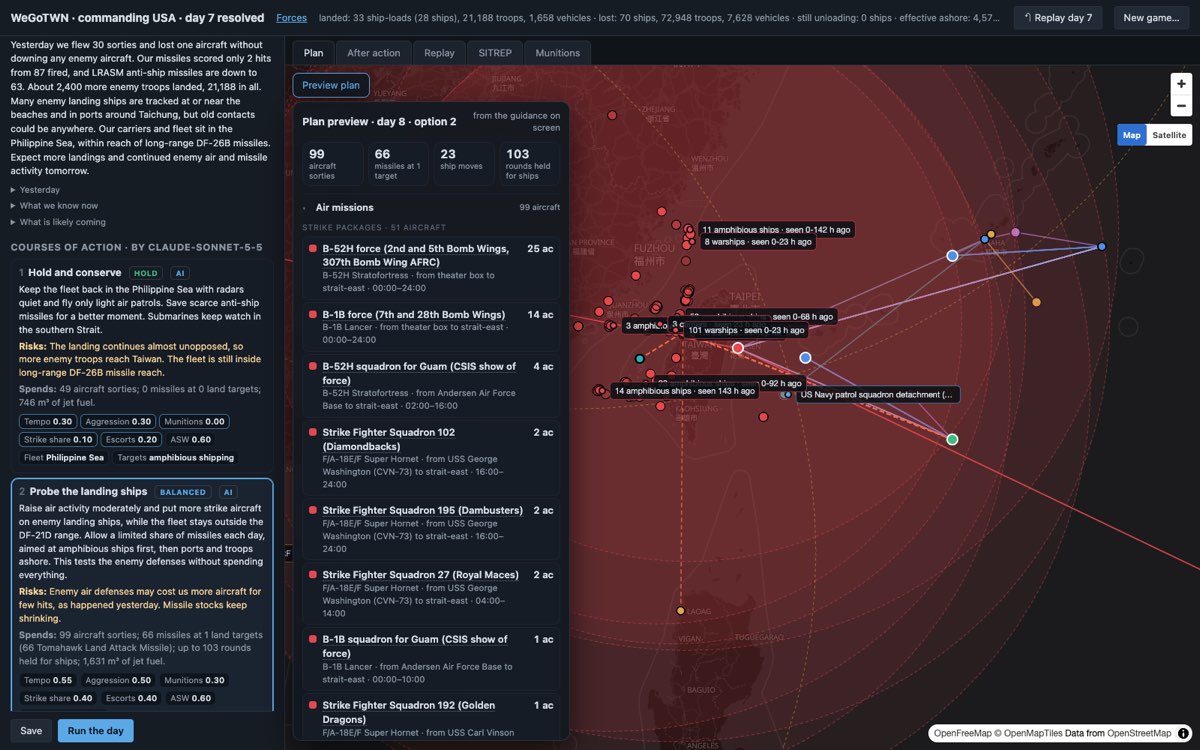
Across the Strait is a browser wargame of a Chinese invasion of Taiwan beginning on 27 April 2027. You are the US theater commander; a rules-based opponent plays China. You set guidance once a day, the server simulates the next 24 hours hour by hour for every side, and you replay the day through your own fog of war: what your sensors did not see, you do not know.
How a day works
- BriefingWhat happened yesterday, what you know now and what is likely coming, with callouts on the map.
- Three courses of actionComplete plans for the day; one always holds and conserves forces and munitions.
- Refine in wordsAsk for a change in plain language; the plan is revised and checked by the engine.
- Run the dayEvery side's aircraft, ships and missiles are simulated hour by hour.
- After actionYour losses, the enemy's as you saw them, a replay of the day and a situation report.
What it models
- MissilesBallistic, cruise and anti-ship salvos against bases, ships and air defences, from finite stocks.
- The air warCombat air patrols, strike packages, tankers and air defences, sortie by sortie.
- The amphibious fleetLanding ships crossing the strait, the fight at the beaches and troops coming ashore.
- Fuel and munitionsJet and marine fuel at each base, burn per sortie and per ship, munitions by weapon.
- Ground combat ashoreFighting over a map of named land areas on Taiwan, including drones.
- Six sidesThe United States, China, Taiwan, Japan, the Philippines, and Australia with the United Kingdom.
Open sources
The game and its data are built entirely from publicly available, open sources. Every number is cited to an open source or labelled as the project's own estimate; nothing classified or otherwise restricted is used.
It is meant for studying how such a conflict could unfold, and why deterrence and preparedness matter. It is not meant to promote or advocate a conflict with China or anyone else. It is an independent project, not affiliated with or endorsed by any government or organisation.